ChatticaAI Help Center

What can we help you bring to life?

Setup guides, feature walkthroughs, and clear answers for every part of ChatticaAI.

/
01

Getting started

From download to your first reply

Quick start: your first conversationAbout 5 minutes

ChatticaAI is the interface for your stories; an AI provider supplies the model that writes replies. You only need three things to begin.

  1. Connect a provider.Open Settings → API Settings, select a provider, add its key or local address, choose a model, and run the connection test.
  2. Add someone to talk to.Open Library, tap +, then create a character or import a compatible card.
  3. Start the conversation.Open the character, choose Story or Texting, select a persona if you use one, and send your first message.
New to AI providers? Open the provider guide below before creating a character. Provider charges are separate from a ChatticaAI plan.
Supported devices and requirementsCompatibility

ChatticaAI is available for iPhone, iPad, and Android phones and tablets. Apple lists iOS/iPadOS 16 or later; the app also runs on Apple-silicon Macs (macOS 12 or later). A native Windows edition is in preparation—see the Desktop page for status. The app is rated 18+.

Core local use does not require a ChatticaAI account. Sign in with Apple or Google is used when you need to purchase or restore a current subscription across devices.

Find your way around the appNavigation

The bottom bar has six tabs, and you can make it yours:

  • LibraryYour characters, group chats, and Adventures.
  • ChatYour active conversation surface. This tab renames itself to Story, Texting, or Adventure to match what you are running.
  • CreateBuild characters and other content with guided tools.
  • PersonasThe identity, perspective, and details you bring into a conversation.
  • WorkspaceDirect model conversations organized into folders, optionally using personas and memory.
  • SettingsProviders, models, appearance, data tools, plans, and advanced behavior.

In Settings you can reorder the tabs and hide Create, Personas, or Workspace if you prefer a smaller bar.

Age verification and the 18+ ratingAudience

ChatticaAI is intended for adults 18 and older. On iOS the app can use Apple’s Declared Age Range, and on Android it supports Google Play Age Signals; where neither is available, a simple birth-year check is used. The complete content and prohibited-use policy lives in the Terms of Service.

02

AI providers

Connect the intelligence behind the story

What “bring your own provider” meansStart here

ChatticaAI does not resell AI messages. Instead, the app connects from your device to a provider you choose. This gives you control over model selection, context limits, provider privacy terms, and usage cost.

ChatticaAI planUnlocks app features.
Provider balancePays for generated text, images, or voice.
Local modelRuns on your hardware instead of a paid cloud API.
Every supported chat providerReference

ChatticaAI ships with built-in support for the following providers (labels as they appear in API Settings):

Cloud services: Alibaba Token Plan · OpenRouter · Featherless AI · LiteRouter · Anthropic (Claude) · OpenAI · xAI (Grok) · NanoGPT · DeepSeek · Google Gemini · Z.AI · NovelAI · Mistral AI · Chutes · NVIDIA NIM · Ollama Cloud

Local servers: LM Studio (Local) · KoboldCPP (Local) · Ollama (Local)

Anything else: Custom (OpenAI-compatible) — connect any service that speaks the OpenAI chat format, including proxies and self-hosted gateways.

Cloud provider availability, pricing, and model catalogs are controlled by each provider and can change at any time. Free tiers and rate limits also come from the provider, not ChatticaAI.

Set up NanoGPTText, image, and voice options
  1. Create an account.Visit NanoGPT, add credit, and create an API key.
  2. Open API Settings.In ChatticaAI, open Settings → API Settings and select NanoGPT.
  3. Save the key.Paste it exactly, refresh the model list, and choose a chat model.
  4. Test before chatting.Use the built-in test. A successful result confirms the address, key, and model work together.

NanoGPT can also serve as an image-generation and text-to-speech provider, and its LoRA library is available for image prompts—see the Images and Voice sections.

Keep your key private. Treat it like a password. Never put a provider key into a character card or public Discord message.
Set up OpenRouterMany models, one key
  1. Create an account at OpenRouter, create a key, and add credit if your chosen model requires it.
  2. In ChatticaAI, open Settings → API Settings and choose OpenRouter.
  3. Paste the key, save, and refresh models.
  4. Pick a model and run Test Chat.

Free models can be rate-limited or change availability. If a previously working free model fails, refresh the list and test a different model before changing other settings.

Set up a first-party provider (OpenAI, Claude, Gemini, and more)Direct keys

First-party cloud providers work the same way: create an API key in the provider’s own dashboard, select the provider in API Settings, paste the key, refresh the model list, and test. Built-in first-party options include OpenAI, Anthropic (Claude), Google Gemini, DeepSeek, xAI (Grok), Mistral AI, Z.AI, NovelAI, Chutes, NVIDIA NIM, Featherless AI, LiteRouter, and Alibaba Token Plan.

Watch two things when mixing providers: context limits differ per model (set Context Window to match the model), and reasoning models expose extra controls such as a Reasoning token budget. If a reply fails immediately after switching providers, run the connection test before adjusting anything else.

Use an OpenAI-compatible or custom serviceAdvanced connection

Choose Custom (OpenAI-compatible) when a service speaks the OpenAI chat format. You will normally need a base URL, an API key if the service requires one, and a model identifier. Copy each value from the provider’s own dashboard or documentation.

  1. Select Custom (OpenAI-compatible) in API Settings.
  2. Enter the provider’s base URL without inventing extra path segments.
  3. Add the key and refresh the list. If discovery is unsupported, enter the model name exactly.
  4. Test the connection, then adjust streaming, reasoning, or context options only after a basic reply succeeds.
Connect LM Studio, KoboldCPP, or Ollama (local)Local network
  1. Start the model server.Load a model on your computer and enable its local API server (LM Studio server, KoboldCPP launcher, or ollama serve).
  2. Allow network access.The server must listen on your computer’s LAN address—not only localhost—for a phone or tablet to reach it.
  3. Use the same network.Put both devices on the same Wi-Fi and enter the computer’s local IP and port in ChatticaAI, selecting the matching provider (LM Studio, KoboldCPP, or Ollama).
  4. Test.If it fails, check the server log, firewall permission, address, port, and API format before changing models.
Important: localhost on your phone means the phone itself. Use the computer’s local network address instead.
Tool Call: a helper model for special jobsSecondary model

Beyond your main chat model, ChatticaAI can configure a Tool Call model—a smaller utility model used for background jobs such as analyzing attached images on models without native vision. You can set its provider, model, and max tokens in API Settings.

Tool Call is also the engine behind ChatticaAI’s model tools: supported models can search chat history, retrieve session memory, and request a dice roll. Dice requests are only proposals—the roll always happens through Chattica’s visible dice flow with you confirming it, so a model can never roll for you silently.

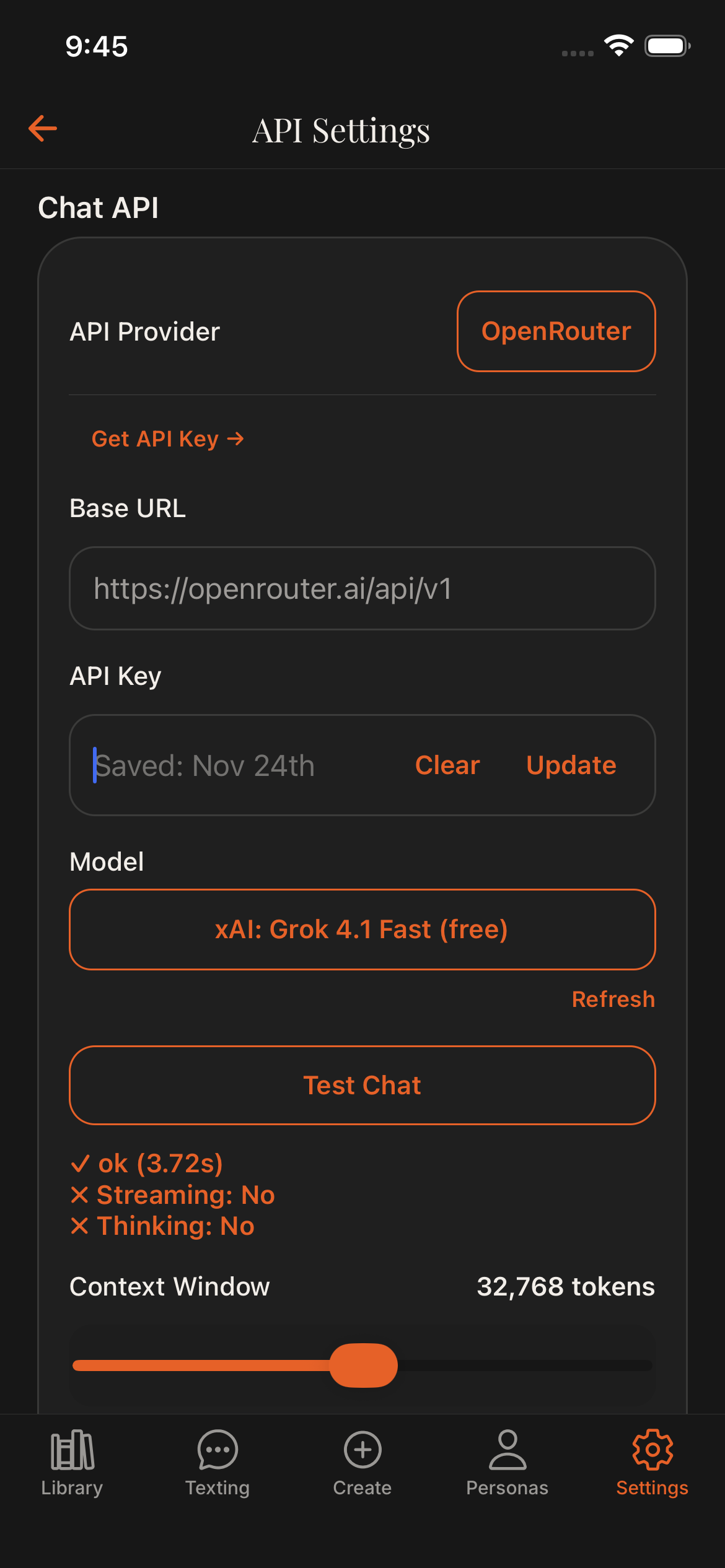
Chat API settings with provider, model, context, and connection test controls
Provider settings put the endpoint, key, model, and context controls in one place.
03

Characters & personas

Build the cast and decide who you are

Create a characterManual or Assisted Creator
  1. Open Create or tap + in the Library.
  2. Choose manual creation or the Assisted Character Creator (there is also an Assisted Scenario Creator for world setups). These ask guided questions and draft the fields for you.
  3. Set the character’s identity, personality, appearance, scenario, and opening greeting. Richer, non-conflicting details usually produce more consistent replies.
  4. Add an avatar and any alternate greetings you want saved with the card.
  5. Review the preview, edit attributes inline if offered, then save.
Character card anatomy: what each field doesDeep dive

Character cards are just structured prompts. Knowing what each field does makes casting far more predictable:

  • Name & avatarHow the character is labeled in chat and who “speaks” each reply.
  • DescriptionThe core dossier—appearance, history, temperament. Sent with every request.
  • Personality / summaryA compressed sketch of traits; useful when description is long.
  • ScenarioThe situation the conversation starts from.
  • First message & alternatesThe opening message. Alternate greetings let you swap in different openings without editing the card.
  • Example dialogueFew-shot samples that teach the model the character’s voice, formatting, and length.
  • Creator notes & tagsFor you and other players—organize the Library with tags.

When a card misbehaves, look for contradictions between these fields first (“shy” in description, “bold” in personality) and trim anything repeated. Cards imported from the community can also contain their own prompt instructions—review system text and extensions before using a card.

Import a character cardPNG, JSON, CHARX, or link
  1. Open Library and use the add/import action.
  2. Select the source: a supported local file (PNG card with embedded data, JSON, or CHARX) or a link to a hosted card—URL import detects the source platform automatically.
  3. Review imported names, greetings, lore, and media before saving.
  4. If an older or nonstandard card imports partially, edit the missing fields manually and keep the original file as a backup.

SillyTavern-style V2/V3 JSON and Ali:Chat-format cards are supported. You can also import SillyTavern chat logs—see Data & privacy.

Create and use personasYour role in the story

A persona tells the model who you are in a conversation. Give it a clear name, description, perspective, and optional image. You can maintain different personas for different worlds and select one per conversation. Workspace chats can also use optional personas, and each persona can keep its own workspace memories.

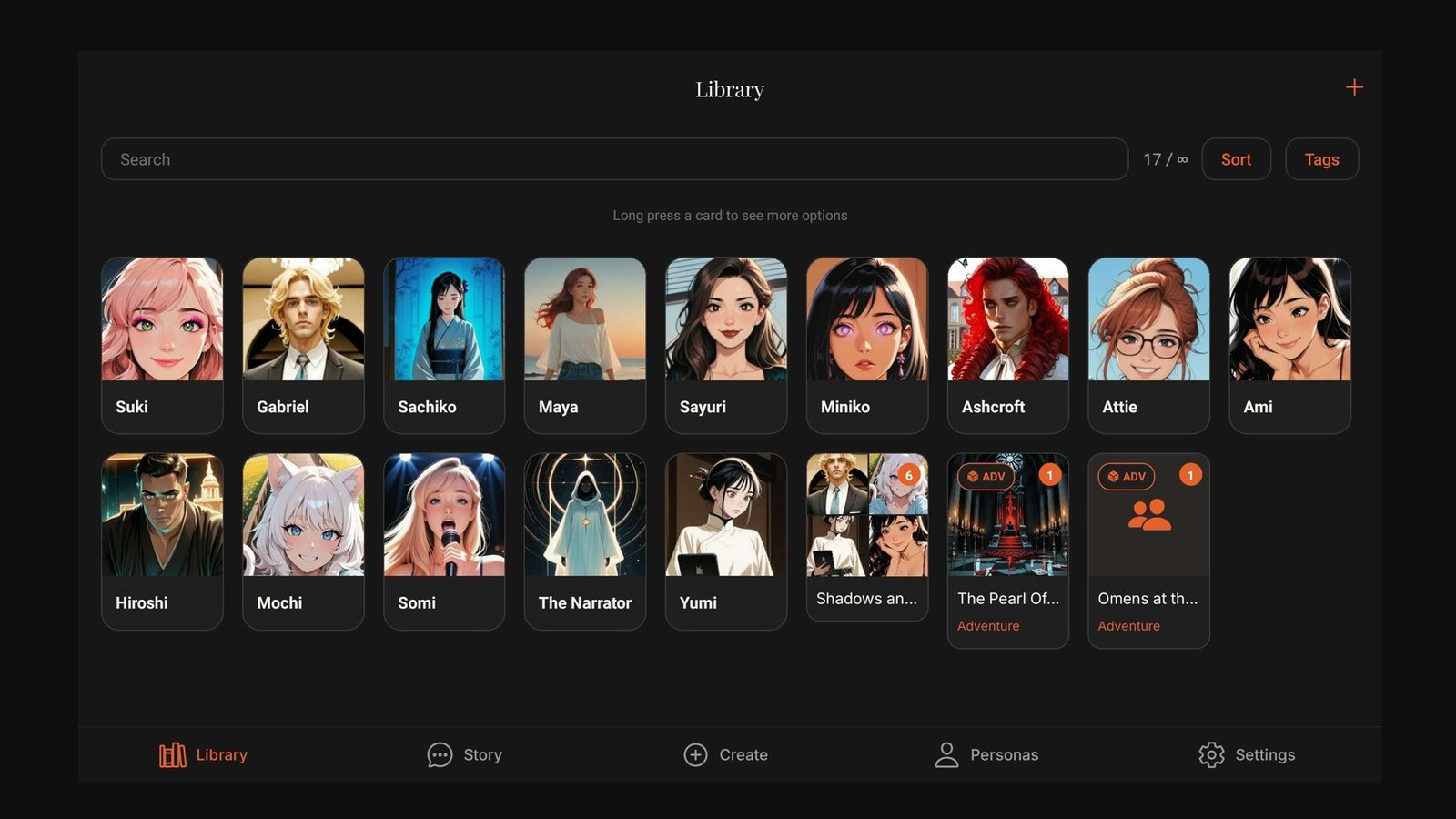
Organize the LibrarySearch, sort, and tags

Library search finds characters and stories by name; sort and tag controls separate worlds, genres, or active stories. Depending on your layout, long-press or open a card’s menu for actions such as edit, export, duplicate, or delete.

Plan note: Library search, sort, and tags are Subscriber/Supporter features. The Free plan holds up to 2 characters and 1 persona without them.
Library search, tags, and character cards on tablet
The tablet layout keeps a large cast visible without hiding search and filters.
Per-character settings worth knowingCustomization

Each character card carries its own production settings, editable from the card’s edit screen:

  • VoiceA text-to-speech voice can be set per character so everyone sounds different—see Voice.
  • Image style & POVStore a preferred art style and point of view used for image generation of this character.
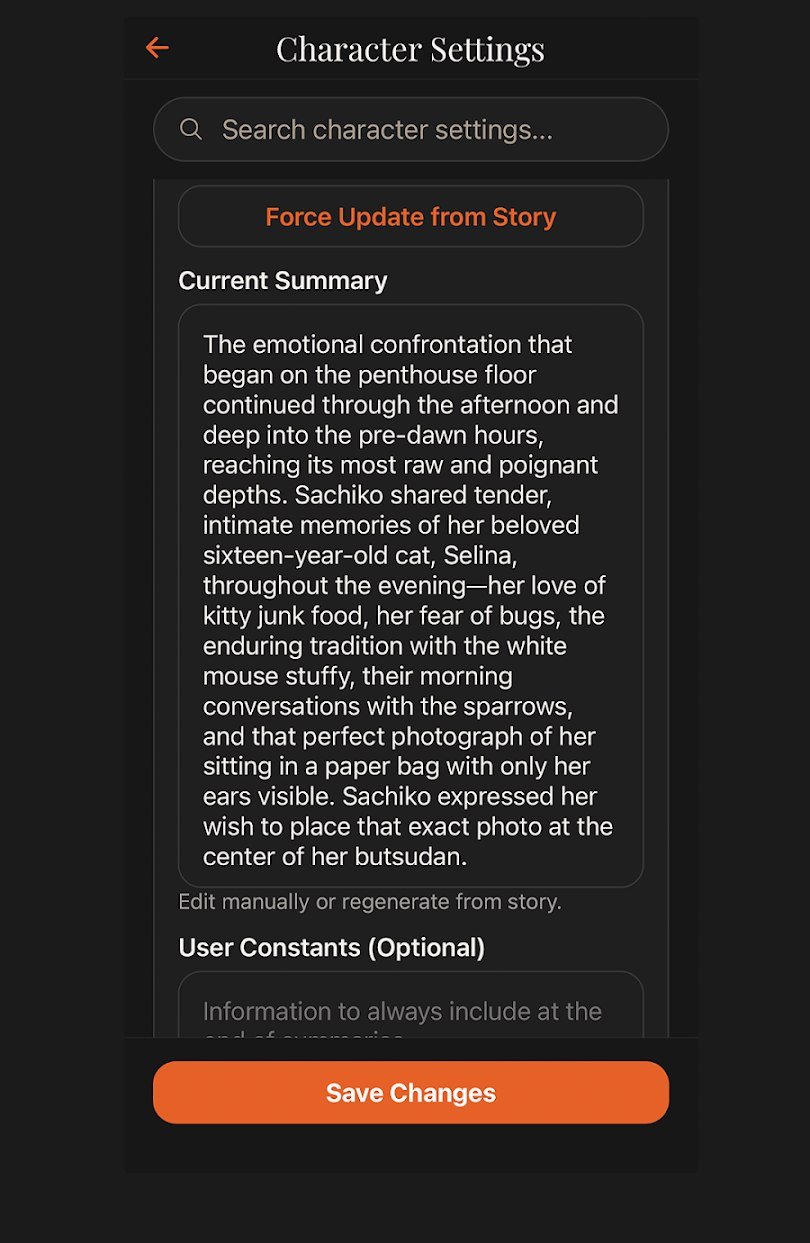
  • Tracked fieldsChoose what ChatticaAI tracks about this character—mood, relationship status, location, inventory—and force an update from the story at any time.
  • MemoryDurable memories and the current story summary live with the character and can be edited directly.
04

Story, Texting & Workspace

Choose the right shape for the conversation

Use Story ModeImmersive roleplay

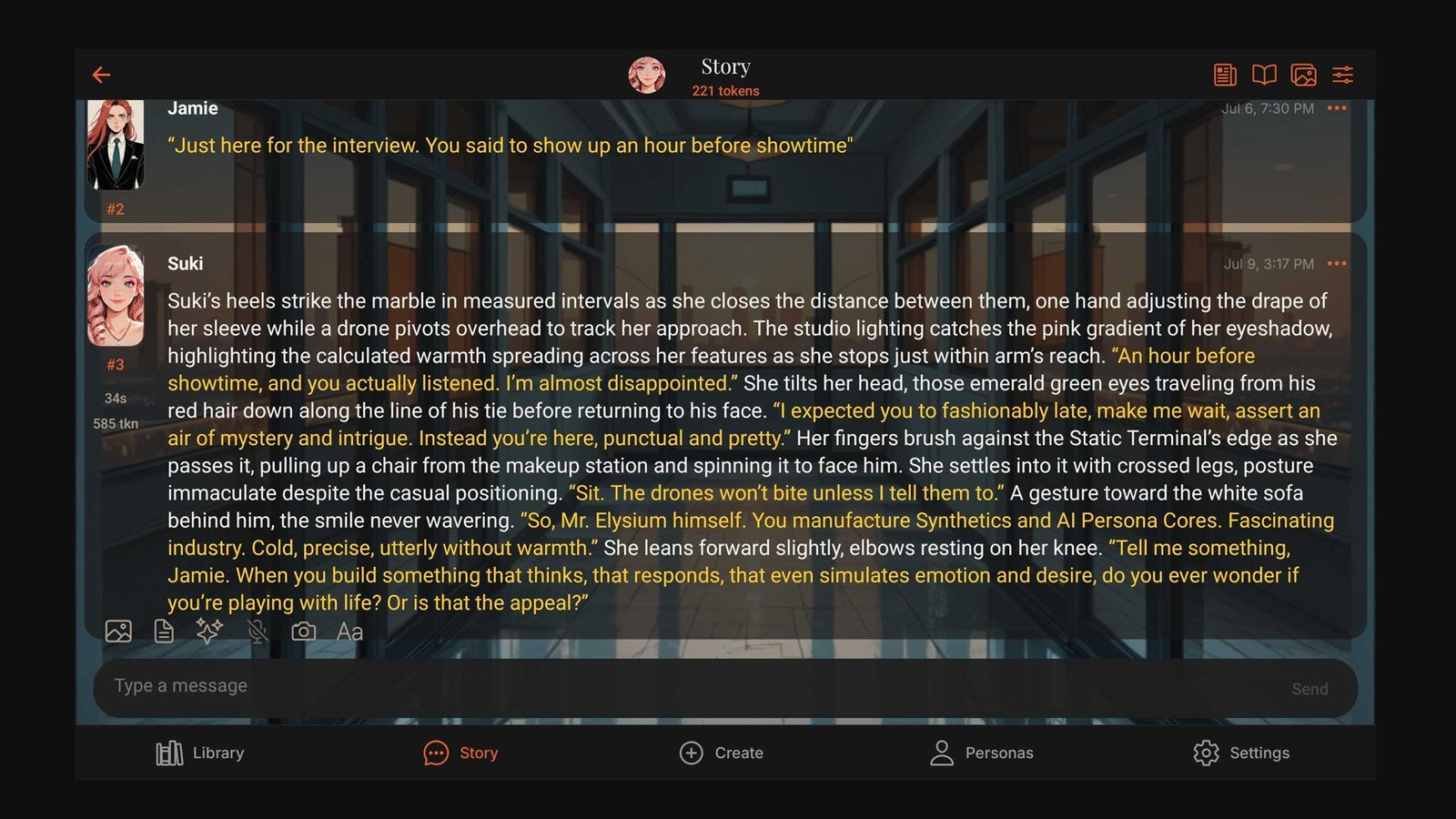
Story Mode is designed for scenes with narration, action, and dialogue. Open a character or group, choose Story, then use chat settings to tune the model, context, formatting, and visual background for that session.

Long-form Story mode on tablet
Story Mode uses the full canvas for long-form reading and visual scenes.
Use Texting ModeFast, familiar messaging

Texting Mode keeps the exchange compact and conversational. It uses the same underlying character and provider settings, but presents replies in a familiar messaging rhythm. Use it when you want less prose and quicker turns.

Branch, retry, and compare repliesExplore another path

Every reply can have variants. Retry a message to generate a new version without losing the previous one, then swipe between variants to compare. Two more tools live in each message’s menu:

  • Rewind to HereRoll the conversation back to this message.
  • Branch from HereStart a divergent timeline from this moment. A branch switcher lets you move between timelines without giving up any of them.

How far the model wanders between swipes is tunable: the Swipe Temperature Variance preset field makes retries more or less adventurous—see Generation controls.

Use Workspace for direct model chatsFolders, files, and history

Workspace is for conversations with a model that do not need a character card. Organize chats into folders, choose a model per chat, search history from the header, and optionally add a persona with its own persona memories.

Attachments: attach images or text files to a message. Supported text types are txt, md, markdown, json, jsonl, csv, tsv, xml, yaml, and yml, up to 512 KB (about 180,000 characters) per file. PDF and office documents are not yet supported. Vision-capable chat models can inspect images directly; the Tool Call model can provide a fallback for models without native vision.

Search chat historyJump to the moment

Open history search from the conversation controls, enter a distinctive word or phrase, then select a result to jump to that message. If results are too broad, search for a character name, location, or exact phrase from the scene. Supported models can also search history themselves via the model tools—see Tool Call.

05

Adventure & groups

Play with a party or build a whole world

Start an AdventureGuided roleplay
  1. Create or open an Adventure from the Library. Adventure Mode requires a Subscriber or Supporter plan.
  2. Choose the characters and persona that form the party, or use assisted party generation to draft adventurers with personalities and relationships.
  3. Review the premise, narrator, rules, and starting scene.
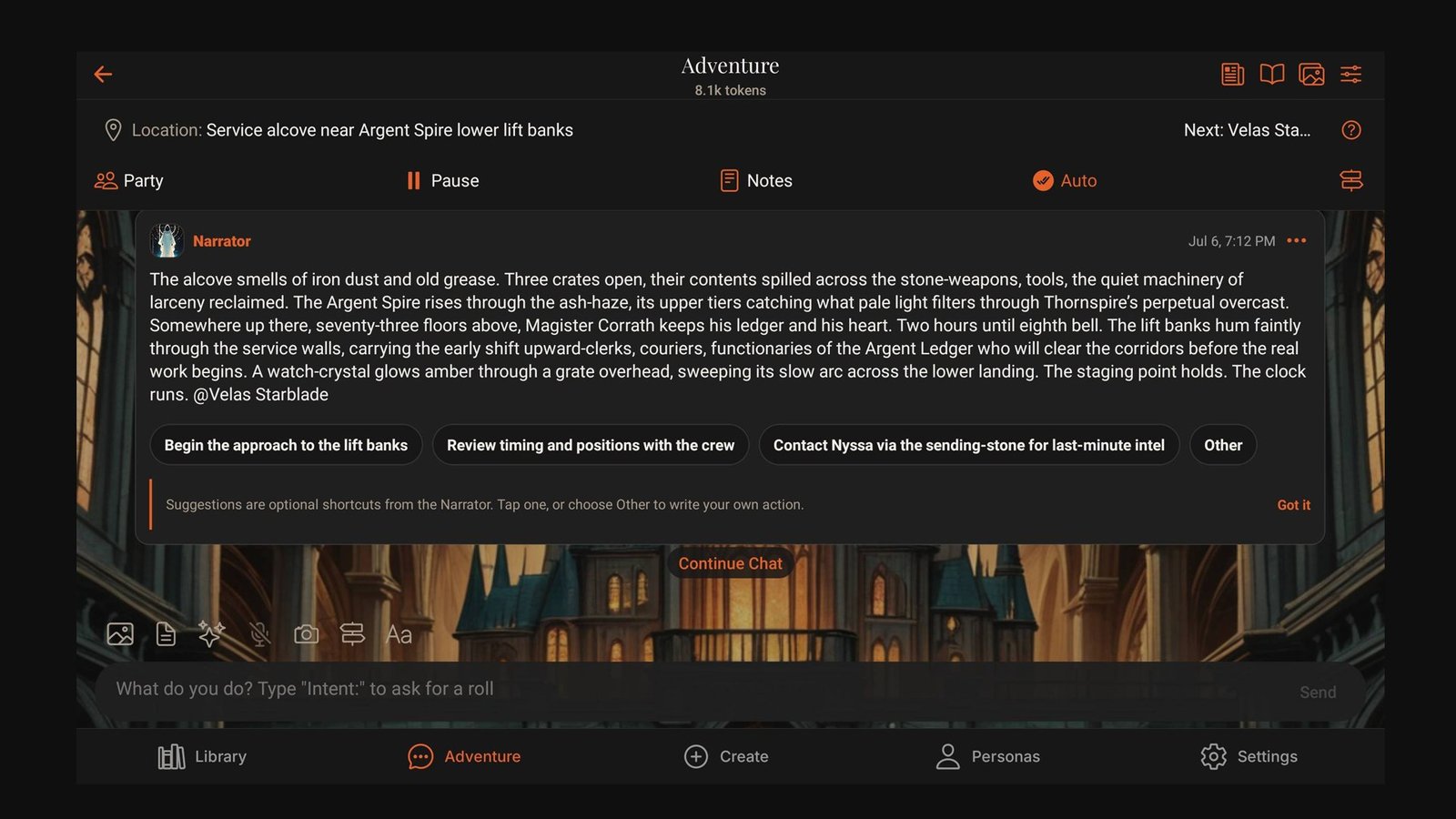
  4. Begin, then choose one of the narrator’s three suggested actions or write your own. Use Intent / Ask for a roll when you want the narrator to call for a check—for example “Intent: pick the lock.”
  5. Use Notes, Party, and Pause to manage the run; export it as an Adventure PNG when you want to share or save the setup.
Adventure Mode with narrator suggestions and party controls
Suggestions are optional shortcuts; you can always write your own action.
Understand Adventure controlsToolbar reference
  • Location: …Shows where the party currently is in the world.
  • Next: …Shows the upcoming scene or progression target.
  • PartyReview or manage the characters taking part.
  • Pause / PausedStops automatic scene progression while you review or steer.
  • NotesPlayer-facing notes kept with the current run.
  • AutoControls automatic acceptance of scene notes for faster play.
  • Start Encounter · Party Order / InitiativeRuns combat-style scenes with explicit turn order.
Dice, Intent, and player-approved rollsOutcomes stay yours

When a scene calls for a check, the narrator proposes a roll—intent, difficulty class (DC), and dice such as d20+2. ChatticaAI turns that into a prefilled dice prompt on your side: you see the proposed roll, adjust the modifier if needed, and confirm it yourself. The model never rolls secretly; “secret” checks are revealed through the same flow. You can also ask for a roll directly with Intent / Ask for a roll, or use the plain Roll action.

The same principle powers model tools: a supported model may request a dice roll as a tool, but the roll only happens through the visible dice flow with your confirmation.

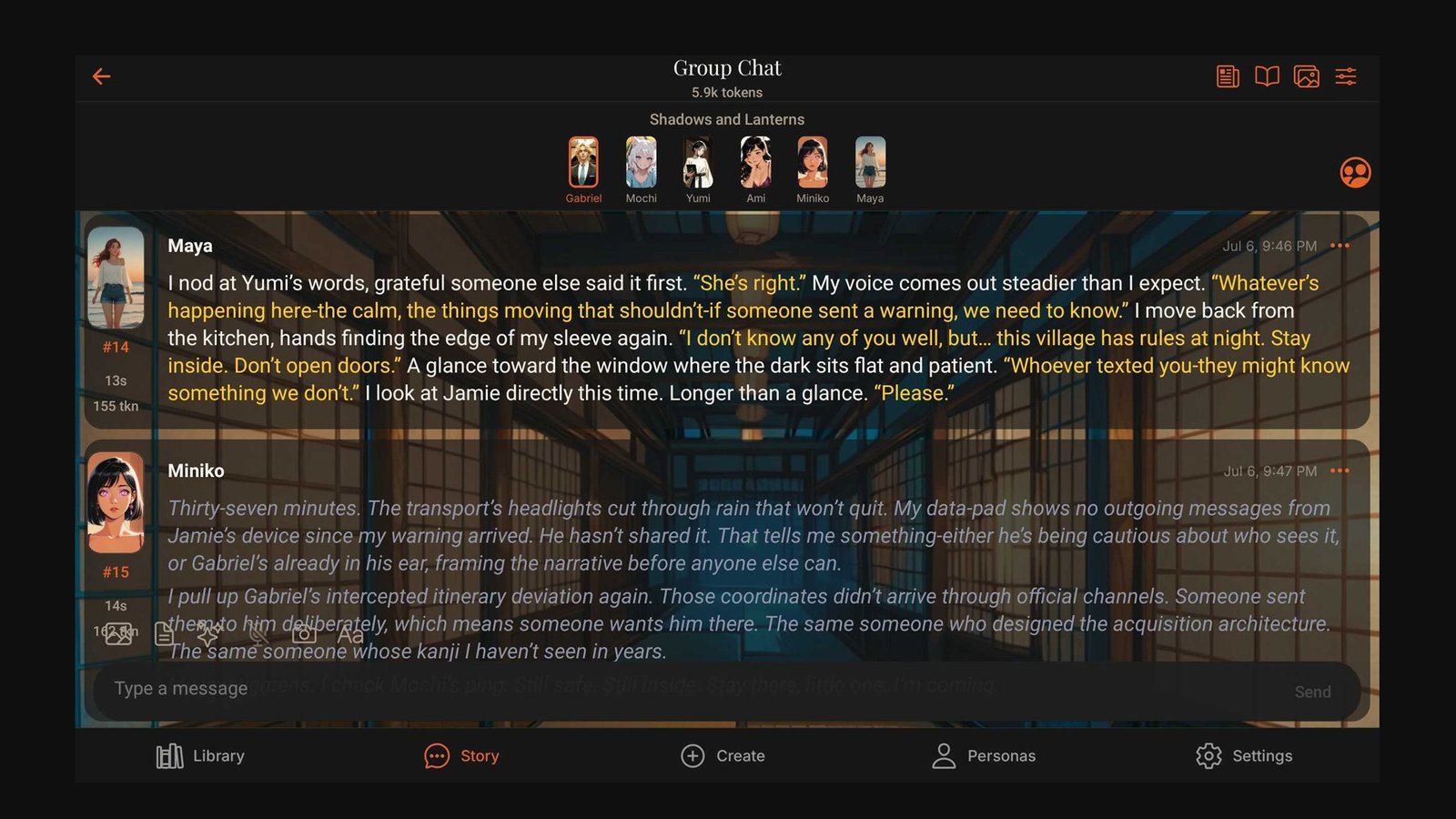
Create a group chatMultiple characters
  1. Create a group from the Library and select its characters (2–6 per group). Group chats require a Subscriber or Supporter plan.
  2. Set the group title, scenario, and opening context—generation is assisted if you want a draft.
  3. Choose who replies: Manual, Ordered (every character replies in turn, then you), or Random. Auto self-replies with a delay are also available.
  4. Direct the scene with @mentions—mentioning a character takes priority over the normal speaker selection.

Each participant keeps its own tracked state and memory, helping a larger cast remain coherent over time.

Group chat with multiple character perspectives
Share an Adventure as PNGPortability

From the chat export menu, Adventure PNG packages the Adventure’s setup—party, scenario, and starting data—into a single image file. Import the PNG on another device or share it with a friend to reproduce the run. Regular chats can be exported as Chattica archives, HTML, SillyTavern JSONL, plain text, or XML—see Data & privacy.

06

Memory & context

Keep what matters, review what changes

How ChatticaAI memory worksOverview

Models only see the context ChatticaAI sends with each request. To preserve continuity beyond the immediate message window, the app maintains three layers:

Recent contextThe active portion of the chat.
Story summaryA compressed account of the session, used by Efficient Context and always editable.
MemoriesDurable facts recalled when relevant—kept on your device.

Relevance matching runs on-device: ChatticaAI ships with a bundled embedding model, so deciding which memories matter for a given reply never sends your library to a server.

Review and approve memory proposalsYou stay in control
  1. When extraction completes, ChatticaAI prepares a memory update proposal.
  2. Review each proposed addition or change—existing memories remain unchanged until you approve.
  3. Edit wording, owner, or category before applying; filter by owner or category when working with a large set.
  4. Apply the approved set. Changes are applied atomically—either the whole approved batch lands, or nothing does.

Failed extractions can be retried from the memory screen without regenerating the chat.

Tracked fields: mood, relationships, location, inventoryLiving state

Beyond freeform memories, ChatticaAI tracks structured state per character or persona: mood, relationship status, location, and inventory. These update as the story moves and are visible in character settings.

If tracked state drifts from what you remember, use Force Update from Story on the character to re-read the recent conversation and correct the fields immediately. In groups and Adventures, tracked state is kept per character, so each member of the cast stays distinct.

Rebuild memories or force a summary updateRepair continuity

Use Rebuild from Full Chat when stored memories no longer represent the conversation or after importing a long chat. Rebuilding reads the available chat again and produces a fresh proposal set; it may use provider tokens. For a smaller correction, edit the current story summary manually.

Character Settings with a current story summary and memory controls
Summaries are visible and editable instead of being hidden model state.
Efficient Context, explainedToken controls

Efficient Context optimizes the conversation history sent with each reply. It keeps complete recent exchanges together, preserves your pinned opening and recent messages, and uses your story summaries when available. In long chats it ranks older exchanges by importance, recency, and redundancy, and uses a smaller adaptive input target for larger context windows. The result is lower token use and cost—without changing your saved chat or deleting anything.

Start with the provider default and enable Efficient Context for long campaigns. Do not set Context Window higher than the selected model actually supports; oversized windows are a common cause of provider errors.

07

Lorebooks & prompting

World knowledge and reusable instructions

Lorebook fundamentalsStart here

A lorebook is a set of world facts injected into the prompt only when they matter. Each entry has:

  • Primary keysWords in recent chat that trigger the entry (“Nariman”, “the Static Terminal”).
  • ContentWhat gets injected when the entry activates.
  • Activation strategyConstant (always included), Keyword (triggered by keys), or Vector (included when meaning—not just exact words—matches, using on-device embeddings).
  • Secondary keys & selective logicRequire extra conditions: the entry fires only when the selective logic (AND ANY / AND ALL / NOT ANY / NOT ALL) is satisfied alongside the primary keys.

Keep entries short and specific. Ten tight entries beat one essay: the lorebook shares a token budget with the rest of your prompt.

Placement: where entries land in the promptPrompt surgery

Each entry’s insertion position decides where its content sits in the assembled prompt:

  • Before / after characterAround the character definition—good for lore that should read as part of the card.
  • Before / after example messagesAround the dialogue examples.
  • Top / bottom Author’s NoteThe classic nudges—strong influence near the end of the prompt.
  • At chat depthInjected N messages back from the end, paired with the entry’s depth value.
  • System / user / assistant rolesPlaced as a specific role—for advanced formatting control.

Rule of thumb: stable world facts early, situational state late. Entries closer to the end of the prompt influence the next reply more strongly.

Advanced entry controlsProbability, recursion, timing
  • ProbabilityChance the entry activates when triggered—use for flavor that shouldn’t appear every time.
  • DepthHow many messages back an at-depth entry is placed.
  • Case sensitiveRequire exact casing for keys.
  • RecursionLet entries triggered by other entries’ content: set a recursion level and policy (none, prevent further, or delay until recursion) to stop chains from snowballing.
  • Sticky / cooldown / delayKeep an entry active for N messages after firing, block refiring for N messages, or wait N messages before it can activate.
  • Ignore budgetForce an entry in even when the lorebook token cap is full.

The lorebook token budget defaults to 5,000 tokens shared across all matching entries; raise it for lore-heavy worlds if your model’s context allows.

Prompt ProfilesReusable instruction sets

Prompt Profiles (Settings → Prompt Profiles, also selectable from completion presets) store complete prompt arrangements so you can switch styles without rebuilding settings: one profile for prose-heavy Story play, another for fast Texting, a third for strict Adventure narration. Profiles work together with per-chat settings—your chat can override a profile without editing it.

Custom macrosDynamic details

Macros are placeholders that expand when a prompt is built—the familiar {{user}} and {{char}}, plus dynamic helpers like random picks and roll summaries. Custom Macros (Settings → Custom Macros) let you define your own: store a character’s nickname, a world’s calendar date, or a running tally, then reference it in cards, lorebooks, and prompts. Update the macro once and every prompt that uses it stays in sync.

08

Generation controls

Shape how the model writes

The Chat API settings cardPer-chat connection controls
  • API Provider & keyWhich service and credential this chat uses.
  • Context WindowHow much conversation the model receives. Match the model’s real limit; higher is not better.
  • Efficient ContextSmarter history selection for long chats—see Memory & context.
  • Max TokensUpper bound on reply length.
  • Reasoning token budgetFor reasoning models: how much thinking they may do before answering.
  • Reasoning preferenceForce reasoning on, or show reasoning output when the model exposes it.
  • Streaming responsesWatch replies write themselves; disable if a provider or proxy mishandles streams.
Samplers: temperature, Top P/K/A, Min PPresets deep dive

Completion presets (per model, reusable) expose the classic sampling controls:

  • TemperatureCreativity vs. consistency. Around 0.7–1.0 suits most roleplay; lower for precision, higher for chaos.
  • Top PKeeps only the most probable words whose cumulative probability reaches P. 0.9–1.0 is typical; lower narrows word choice.
  • Top K / Top A / Min PAlternative cutoffs. Min P scales with temperature and is a favorite for creative models; Top K is a fixed candidate count.
  • Swipe Temperature VarianceHow much the temperature shifts between retries—higher gives more variety across swipes.

Change one control at a time and retest with the same prompt; sampler effects are easiest to feel when isolated.

Penalties, DRY, logit bias, and banned tokensFighting repetition

When a model starts looping phrases, these are the levers, roughly in the order to try them:

  • Frequency / Presence penaltyDiscourage tokens the model has already used (frequency scales with how often; presence is a flat nudge).
  • Repetition penalty & slopePenalize repeated tokens with adjustable strength and ramp-up.
  • DRY penaltyTargets repeating sequence patterns rather than single tokens—Multiplier, Base, Allowed length, and Penalty range. The go-to fix for stubborn loops.
  • Logit bias & banned tokensHard steering: bias toward or away from specific tokens, or ban words entirely.

Start gentle. Stacked penalties at high values are the most common cause of degraded prose.

09

Images

Add sight and atmosphere

Connect an image providerLocal or cloud

ChatticaAI supports the following image providers: NanoGPT, ComfyUI (Local), Comfy Cloud, Local Stable Diffusion, Stability AI, NovelAI, OpenRouter, Google Gemini, xAI (Grok Imagine), LiteRouter, Alibaba Token Plan, and Custom endpoints.

  1. Open Settings and choose the image-generation area.
  2. Select a provider and add its endpoint and key when required.
  3. Select a model, then run a test or generate a character image before enabling automatic in-chat images.

Image charges, model availability, and content rules come from the provider you select.

Generate images in a conversationManual or automatic

Use the image action in the conversation composer to build a prompt from recent context. Review the prompt, negative prompt, model, style, and point of view before generating. Image style and POV can be stored per character; automatic images can use contextual trigger phrases like “selfie”, “pic”, or “show me” when enabled.

If a result ignores the character, strengthen the character’s visual description and verify that the selected model or LoRA is compatible.

ComfyUI and LoRAsAdvanced setups

For ComfyUI and local Stable Diffusion setups, ChatticaAI can read your local model and LoRA inventory, and the LoRA picker shows NanoGPT LoRAs with their trigger words so prompts activate styles correctly.

Use trigger words exactly as published for each LoRA—“close enough” keywords are the most common reason a style doesn’t appear. Automatically fetching LoRAs from provider catalogs is a Subscriber/Supporter feature.

Attach images and filesVision

Use the attachment action in a supported composer and select an image or text file. Vision-capable chat models can inspect images directly; the Tool Call model can provide a fallback for other supported models. In Adventure, shared images can be presented to the party in-world.

Provider privacy applies. An attachment sent for analysis leaves your device and is processed by the provider you selected.
10

Voice

Speak and be spoken to

Voice input (speech to text)Dictation

Allow microphone access once, then use the speech option in the composer to dictate instead of typing. Recognition uses your platform’s built-in speech capabilities—no ChatticaAI server sits in between.

Text-to-speech providersChoose the voice

Configure a voice provider in Settings, then test a short reply first. Supported options:

  • Device VoiceYour operating system’s native voices—works fully offline.
  • Cloud voicesElevenLabs, LemonFox, Fish Audio (cloud or self-hosted), NanoGPT, and OpenRouter.
  • OpenAI-compatible & customAny local or hosted TTS service that speaks the OpenAI-compatible format, including saved custom providers.

Voice and TTS are Subscriber/Supporter features; usage costs are billed by the voice provider you choose.

Per-character voices and spoken-lines-onlyPerforming the cast

Each character can carry a saved voice profile, so a group reads like a cast instead of a chorus—set it from the character’s edit screen.

Spoken-lines-only mode reads just the dialogue and skips narration. Providers that support emotive capability discovery advertise expressive styles (like whispers or excitement) that ChatticaAI can pick up automatically when available.

11

Data & privacy

Your library should remain yours

What stays local—and what leaves the devicePrivacy model

Characters, chat histories, settings, and the app’s media records live in a local database on your device. Memory-relevance matching uses a bundled on-device embedding model—your library is never uploaded for indexing. ChatticaAI runs no analytics, ads, or tracking, and operates no cloud chat archive.

Three things leave the device, always by your action: requests to the AI, image, or voice providers you configure; purchases via Sign in with Apple/Google; and files you import from a URL.

Read the full Privacy Policy →
Back up and restore app dataProtect your library
  1. Open Settings → Backup & Restore.
  2. Create a backup. ChatticaAI writes a single portable .chattica archive—save it somewhere you control outside the app.
  3. To migrate, install ChatticaAI on the destination device and choose Restore.
  4. Select the backup, keep the app open while it validates and imports, then verify key characters and chats before removing the old copy.
Backups are manual—there is no auto-backup. Local-first storage means deleting the app or losing a device removes data that was never backed up. Keep more than one copy, and keep copies outside the app.
Export chats, characters, and AdventuresPortable formats

From character and conversation menus:

  • Character cardsExport as PNG (with embedded data) or JSON.
  • Chattica Archive (.chattica-chat)A portable chat archive—ChatticaAI’s richest, re-importable format.
  • TranscriptsHTML, SillyTavern JSONL, plain text, or XML.
  • Adventure PNGA shareable image carrying the Adventure’s full setup.

Chat exports as SillyTavern JSONL also import back into ChatticaAI, so you can move histories to and from other tools. Keep exported files unchanged if you plan to import them again.

Delete local data or your accountPermanent actions

Delete individual characters or chats from their menus. Use the app’s data controls for a broader local reset, and make a backup first if you may want the content later. Removing the app also removes local app data unless your operating system preserves it.

If you used Apple or Google sign-in and want the associated account record deleted, follow the account deletion instructions. Deleting an account does not cancel a store subscription; cancel that separately in Apple or Google Play settings.

12

Plans & accounts

Understand purchases and restoration

Compare current plansFree, Subscriber, Supporter
Free2 characters, 1 persona, full chat features, lorebooks, local storage. Without Adventure, group chats, image generation, voice, export, multiple sessions, and Library search/sort/tags.
Supporter · $59.99Everything in Subscriber as a one-time purchase—for the platform where it is bought.

Store prices and taxes can vary by region. The checkout sheet on your device is the authoritative price. Legacy Plus and Premium purchases remain fully honored.

Sign in and restore a purchaseApple or Google
  1. Sign in inside ChatticaAI with the same Apple or Google identity tied to the purchase.
  2. Open the plan or purchase screen and choose Restore Purchases if access does not update automatically.
  3. Give the store a moment to respond, then restart the app once if the entitlement still appears stale.

Subscriber access restores across iOS, Android, and Windows PC when tied to the supported sign-in. Supporter is platform-specific: a Supporter purchase on iOS unlocks iOS.

Cancel a subscription or request a refundStore-managed billing

Apple and Google manage billing. Cancel from your device’s subscription settings; removing the app does not cancel renewal. Refund eligibility and processing are also controlled by the store where you paid.

  • AppleSettings → your name → Subscriptions.
  • Google PlayPlay Store → profile → Payments & subscriptions → Subscriptions.
13

Desktop (Windows)

ChatticaAI, native on your PC

Desktop statusIn preparation

A native Windows edition of ChatticaAI is in active preparation. When it ships, installers and checksums will be published on the Desktop download page—nowhere else. Follow progress in the community Discord.

Which build will fit my PC?x64 vs ARM64

Two Windows builds will be offered. x64 is the right choice for the overwhelming majority of PCs with Intel or AMD processors. ARM64 is for Windows-on-Arm hardware—Snapdragon X and Copilot+ PCs, Surface devices with ARM chips. Check Settings → System → About → System type on your PC. If unsure, choose x64: Windows’ built-in emulation runs it on ARM machines, just less efficiently. The download page includes full guidance and automatic detection.

How desktop updates will workPlanned behavior

The plan for desktop releases: ChatticaAI checks for updates when it launches—quietly, and no more than once every 24 hours—plus a manual Check for Updates action under Help & Support whenever you want one. Every installer is published with a SHA-256 checksum so you can verify your download, and updates are never announced before their installer is actually available.

14

Troubleshooting

Fast checks for common problems

A chat reply fails or never startsProvider check
  1. Open Chat API settings and run the built-in test.
  2. Confirm the provider account has credit and the key has not expired or been revoked.
  3. Refresh models and choose one that is currently available.
  4. Reduce context or output length if the provider reports a limit.
  5. Turn off special reasoning or streaming options temporarily, then test a basic reply.
A model is missing from the pickerRefresh and filters

Refresh the provider’s model list, clear active model filters, and verify the service makes that model available to your account. For compatible custom services that do not support discovery, enter the exact model identifier manually if the selected provider type allows it.

A local model will not connectNetwork check
  1. Confirm the model is loaded and its API server is running.
  2. Open the server address from another device on the same Wi-Fi if the server exposes a status endpoint.
  3. Replace localhost with the computer’s local IP address.
  4. Allow the server through the computer firewall and confirm the port.
  5. Disable VPN or guest-network isolation temporarily if it blocks device-to-device traffic.
Image generation fails or misses the characterImage checks
  1. Run a single manual generation and read the provider error, if any—it names quota, model, or content problems.
  2. Verify the image provider’s endpoint and key, and that the selected model is available on your account.
  3. If the result ignores the character, strengthen the card’s visual description and check that the chosen style or LoRA matches the model.
  4. Use LoRA trigger words exactly as published; check ComfyUI workflow health in the ComfyUI interface itself.
Voice input or TTS is not workingAudio checks
  1. Confirm microphone permission for voice input, or a working device volume for TTS.
  2. For cloud TTS, test the provider with a short phrase and check its balance or quota.
  3. Re-select the voice for the character you are hearing—per-character profiles override your defaults.
  4. If a custom OpenAI-compatible voice provider fails after an update, re-save its saved provider entry and test again.
Memory extraction fails or looks wrongMemory fixes
  1. Retry the failed extraction from the memory screen—failures are usually provider hiccups.
  2. Check that your provider has quota; extraction uses model tokens.
  3. If memories are stale rather than missing, use Rebuild from Full Chat or Force Update from Story for tracked fields.
  4. Review pending proposals: nothing changes until you approve, so a forgotten proposal is often the real cause of “missing” memories.
A purchase is not showingEntitlement check

Verify the store shows the purchase or active subscription, sign into ChatticaAI with the linked identity, then use Restore Purchases. If it still does not appear, send support the platform, app version, plan name, and non-sensitive store receipt details. Never send an API key.

Report a bug that we can reproduceBest support details

Include your device and OS version, ChatticaAI version (Settings shows it), the screen or feature involved, what you expected, what happened, and the shortest sequence that reproduces it. Add a screenshot or redacted error message when helpful. Do not include API keys, private character cards, or sensitive conversation text.

15

Frequently asked questions

Short answers to the big questions

Is ChatticaAI free?Plans

You can start with the Free plan: 2 characters, 1 persona, full chat features, lorebooks, and local storage. Your chosen AI, image, or voice provider may charge separately for usage. Subscriber ($2.99/mo) and Supporter ($59.99 once) unlock everything.

Can ChatticaAI work offline?Local models

Your library and all memory matching work offline. Generating a reply requires access to your configured provider—a local model server such as LM Studio, KoboldCPP, or Ollama on the same network counts, and Device Voice TTS is offline too.

Do chats sync between devices?Local-first data

Chats are not cloud-synced. Use Backup & Restore (.chattica) or portable chat archives to move content. Subscription restoration is separate from chat data.

Where are API keys stored?Credentials

Provider credentials are stored in your device’s secure storage (Keychain/Keystore). They are used to connect directly to the provider you selected and are never included in character cards or exports.

Which model should I choose?It depends

Start with a provider’s current general-purpose or roleplay-capable model that fits your budget and context needs. Smaller models are faster and cheaper; larger or reasoning models may follow complex scenes better but cost more and respond more slowly. Match the Context Window setting to the model you pick.

What can models do on their own?Model tools

Very little, by design. Supported models can search your chat history, retrieve session memory, and request a dice roll—each through an approval flow. Dice rolls always happen through the visible dice prompt with your confirmation; a model can never roll for you or act silently.

Why is the app rated 18+?Audience

ChatticaAI is built for adult-created characters and user-directed conversations. Users must be 18 or older and must follow the prohibited-content rules in the Terms of Service.